Stadium Course at Camiral Hole by Hole: The Ryder Cup 2031 Course on the Costa Brava
Discover all 18 holes of the best golf course in Spain, the official venue for the Ryder Cup 2031 in Girona
In 2031, the whole world will turn its eyes to the Stadium Course at Camiral, the golf course that will host the Ryder Cup 2031 on the Costa Brava. A course that has been challenging and captivating amateur and professional golfers from around the world for over 25 years.
But what exactly is this course like, hole by hole? What makes the Stadium Course so special? In this article we tell you everything , so you can arrive prepared, or simply dream about playing it before the big event.
The Stadium Course by the Numbers
Before diving into the holes, here are some key facts worth knowing:
- Par: 72
- Yardage: 7,333 yards from the competition tees
- Designers: Ángel Gallardo and Neil Coles MBE, two European Tour legends
- Opening year: 1999
- Fairway grass: the same type as Augusta National (recently renovated)
- Record: voted best course in Spain in 2012 and 2019 by top100golfcourses.com, and number 4 in continental Europe
All 18 Holes of the Stadium Course , Ryder Cup 2031
Hole 1: The Deceptive Opener Par 4 · Dogleg left
The first hole welcomes you with an impressive avenue of pine trees and over 90 metres of rough that make the tee shot look harder than it really is. The dogleg to the left hides how wide the fairway actually is — there’s more room than it seems. A perfect hole to build confidence if you play it smart.
Ryder Cup tip: professional players will attack the dogleg with drives over 300 metres to shorten the second shot.
Hole 2 Par 4
A demanding hole where drive placement is key. Trees and lateral bunkers punish any wayward shot, while the protected green rewards precision over distance.
Hole 3: The Lakeside Green Par 4 · Green beside the lake
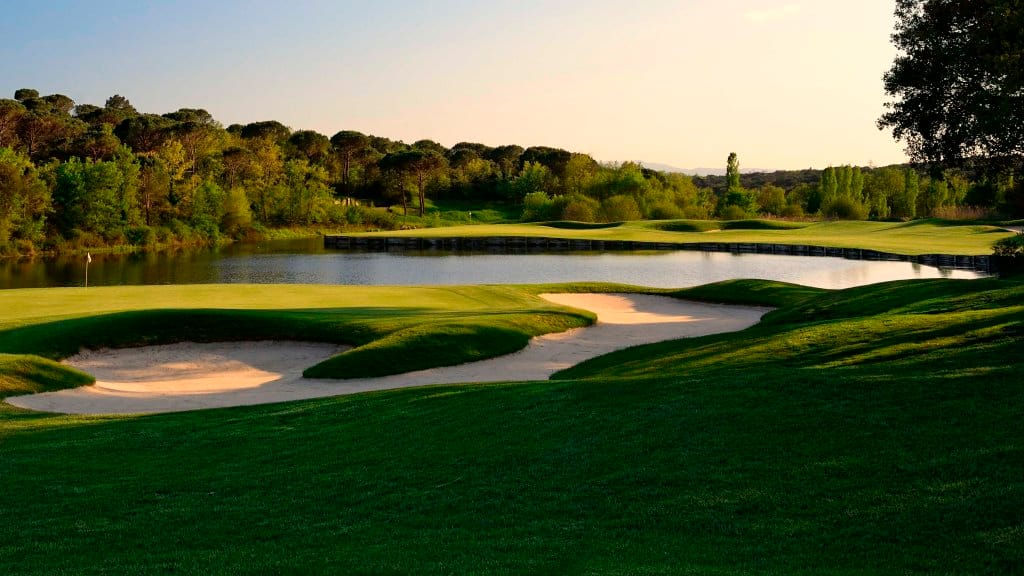
One of the most iconic holes on the course. The green sits beside a lake that comes into play on the second shot, creating one of the most photogenic scenes on the Stadium Course. It was one of the holes reinforced in the renovation carried out in collaboration with the European Tour.
At the Ryder Cup 2031, this hole promises to be one of the most exciting for spectators.
Hole 4 Par 5
The first par 5 of the round offers big hitters the chance to reach the green in two. Course management strategy becomes crucial here , do you go for it or play safe?
Hole 5 Par 4
A technical hole where thick rough and well-positioned bunkers punish long but wayward drives. In the match play format of the Ryder Cup, these kinds of holes tend to generate moments of high tension.
Hole 6: The Renovated One Par 4 · Recently renovated
Hole 6 was completely renovated in 2021 under the direction of Head of Agronomy David Bataller. The entire first half of the hole was remodelled, with large amounts of earth moved to create flatter tee boxes and a more satisfying playing experience. New trees and shrubs add difficulty and beauty in equal measure.
Hole 7 Par 3
The first of four par 3s on the course. The par 3s at the Stadium Course are known for their demanding nature , each one requires a pinpoint approach shot, with water, bunkers or rough waiting for any mistake.
Hole 8 Par 4
A transitional hole heading into the back nine. The pine forest surrounds the fairway creating a natural corridor that turns every shot into an exercise in concentration.
Hole 9: The Longest Par 4 · The longest hole on the course
At over 437 metres, hole 9 is the longest par 4 on the entire Stadium Course. A true test of power and endurance just before the turn. At the Ryder Cup 2031, this hole could be decisive in many matches.
The Stadium Course is no ordinary golf course, it was designed from day one with spectacle in mind. Its name says it all: “Stadium”. The generous spaces between holes, the natural elevations of the terrain and the layout of the greens allow thousands of spectators to follow the action with an unbeatable view.
Add to that an unrivalled competitive history in Spain: it has hosted the Spanish Open on three occasions and countless European Tour events. By the time the Ryder Cup 2031 arrives, the course will have seen everything,but never anything this big.
Hole 10: The Redesigned Dogleg Par 4 · Right-to-left dogleg · Completely redesigned in 2021
Once a straight hole that rewarded the long drive, hole 10 was completely redesigned as a right-to-left dogleg. It now demands the exact length off the tee to set up the ideal position for the second shot into the green. Far more interesting strategically, and far more demanding.
Hole 11: The Imposing Par 3 Par 3 · Renovated
Another hole reinforced in the European Tour renovation. The par 3 at 11 is one of the most imposing on the course, with a green that demands millimetre precision and punishes any wayward shot without mercy.
At the Ryder Cup, par 3s tend to generate the loudest roars from the crowd, and hole 11 has all the ingredients.
Hole 12 Par 5
The second par 5 of the round. Big hitters will try to reach the green in two, but the strategic hazards make the decision to go for it a costly one if it goes wrong.
Hole 13: The Signature Hole Par 4 · The most famous hole · Top 100 Best Holes in Europe
The showpiece hole of the Stadium Course. 385 metres with a lake flanking the left side of the green and spectacular views over the pine forest and the distant silhouette of the Montseny Massif. It has been recognised as one of the 100 best holes in all of Europe, and it deserves it.
At the Ryder Cup 2031, hole 13 will be the television moment of the tournament. Tens of thousands of spectators will surround the green.
Hole 14 Par 3
The third par 3 of the round. By this point in the round, mental fatigue starts to play an important role — and par 3s don’t forgive a lack of concentration.
Hole 15 Par 4
The final stretch of the Stadium Course starts to get serious. A technical hole where pin position on the green can turn an easy birdie into a painful double bogey.
Hole 16 Par 4
With the pressure of the closing holes in the air, hole 16 demands a cool head. The fairway bunkers are strategically placed to punish overly ambitious drives.
Hole 17 Par 3 · The last par 3
The fourth and final par 3 arrives when both legs and mind are feeling the strain. In the Ryder Cup format, reaching the 17th all square is one of the most intense experiences in world golf.
Hole 18: The Grand Finale Par 5 · Renovated with the European Tour
The closing hole of the Stadium Course is pure spectacle. The 18th fairway was widened in the European Tour renovation, creating a finishing hole that can hold over 30,000 spectators thanks to its gentle natural elevations on both sides. The final green, surrounded by the crowd, will be the epicentre of the Ryder Cup 2031.
Picture the moment: Europe and the United States tied, final match, hole 18, Costa Brava. That’s what awaits us in 2031.
Can You Play the Stadium Course Before the Ryder Cup 2031?
Yes, and we highly recommend it. The course is open to visitors year-round with tee time bookings at camiral.com. Playing the Stadium Course before 2031 is the best way to understand why this course was chosen to host the greatest golf event in the world.
Recommended minimum handicap: 26 for outside visitors. Best time to play: May, when temperatures hover around 23°C and the fairways are in peak condition.
Conclusion
The Stadium Course at Camiral is much more than the home of the Ryder Cup 2031, it is a masterpiece of golf design in the heart of the Costa Brava. Every hole has its story, its trap and its reward. In 2031, the whole world will discover it. Now you already know it.
Want to stay up to date with everything related to the Ryder Cup 2031 on the Costa Brava? Follow our blog and don’t miss a thing.